The digitalization of financial services has transformed how we interact with money. Platforms like Revolut, with over 60 million global users as of June 2025, highlight just how quickly fintech adoption is accelerating. From Apple Pay and Google Pay to mobile banking apps and digital investment platforms, finance today is seamless, fast, and embedded into our daily
But this progress comes with a hidden cost: fraudsters are evolving just as quickly. Traditional scams have given way to sophisticated AI powered attacks capable of breaching wallets, deceiving customers, and bypassing outdated security systems. According to the 2025 AFP Payments Fraud and Control Survey Report, 79% of companies faced attempted or actual fraud in 2024 up sharply from 65% just two years earlier. These figures underscore the urgency of new, AI-driven approaches to protecting both institutions and customers.
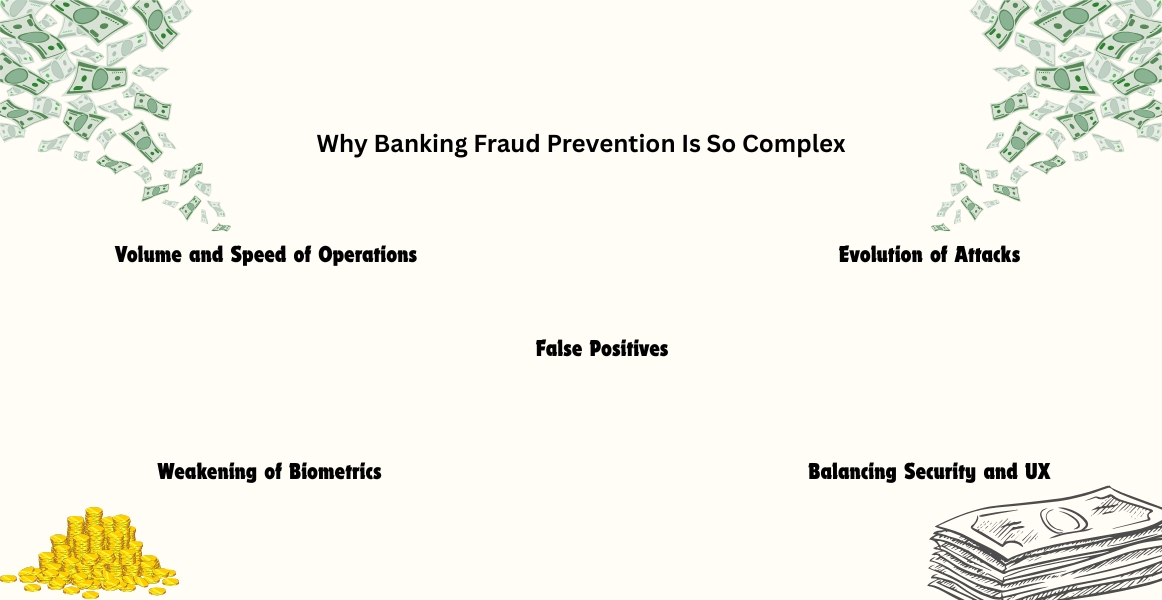
Why Banking Fraud Prevention Is So Complex
Fraud prevention today isn’t just about blocking obvious scams—it’s about detecting subtle, fast moving threats without disrupting user experience. Key challenges include:
- Volume and Speed of Operations
Millions of daily transactions make manual monitoring impossible. Systems must process vast datasets in real time, making split second decisions without stalling legitimate payments.
- Evolution of Attacks
Fraudsters now leverage AI themselves. Deepfake technology fueled over 105,000 reported cases in early 2024 alone, costing more than $200 million. Authorized Push Payment (APP) fraud, “pig butchering” investment scams, and QR phishing (quishing) are just a few modern examples.
- Balancing Security and UX
Customers demand frictionless transactions. Extra checks or blocks often drive frustration and loyalty loss. The best fraud systems operate invisibly, stepping in only when true risks arise.
- False Positives
When legitimate payments are blocked, banks face not only customer anger but also operational costs in resolving disputes. Striking accuracy without over-blocking is critical.
- Weakening of Biometrics
AI-generated deepfakes can convincingly mimic voices and faces, undermining even advanced biometric verification. The shift from static identifiers to dynamic behavioral analysis is now essential.
Personalization is as crucial in B2B as in B2C, especially given complex buying cycles and multiple stakeholders. It’s about understanding a customer’s business needs and offering tailored solutions that save time and reduce costs, says Mohan Natarajan, Services Practice Leader at Klizer.
AI makes this possible by analyzing past purchases and behavior to anticipate needs, provide relevant product recommendations, and deliver seamless, personalized dashboards for a smoother buying experience.
Why Traditional Systems Fail
Classical fraud prevention methods rules based engines, manual reviews, and rigid workflows struggle against AI-enabled fraud. They:
- Only detect known patterns, missing novel schemes.
- React slowly, leading to losses before intervention.
- Generate high false positives, eroding trust.
- Fail to connect activity across channels (apps, online banking, call centers).
In short, legacy systems offer a false sense of security while attackers innovate faster. The solution lies in AI powered, adaptive fraud prevention.
AI-Powered Fraud Detection: The New Standard
The global Fraud Detection and Prevention (FDP) market reflects this shift, expected to surge from $36.5 billion in 2023 to $226 billion by 2033. AI enables:
- Large-scale pattern recognition: ML models analyze structured and unstructured data, from transactions to device metadata, revealing hidden fraud networks.
- Real-time anomaly detection: Systems build unique behavioral profiles and flag deviations instantly.
- Continuous adaptation: Models retrain automatically on new fraud cases, evolving as attackers do.
- Dynamic risk scoring: Each transaction receives a risk score, allowing tiered responses from seamless approval to step up authentication.
Key AI Applications in Banking Security
- Transaction Monitoring: AI models analyze time-series data using algorithms like Isolation Forests and RNNs. They detect unusual transaction patterns such as sudden large transfers inconsistent with a customer’s history, triggering additional verification.
- Behavioral Biometrics: By tracking keystroke speed, cursor movement, scrolling habits, and even device tilt, banks can build unique user “behavioral fingerprints.” Subtle changes reveal when fraudsters use stolen credentials.
- Synthetic Identity Detection: AI cross-checks digital footprints, spotting inconsistencies in credit histories, addresses, or social activity to expose fake profiles before services are granted.
- Account Takeover Prevention: Instead of relying solely on passwords, AI assesses device fingerprints, IP/geolocation mismatches, and session behavior. Suspicious logins trigger adaptive multi-factor authentication.
- Automated KYC & AML: Computer vision and NLP verify documents, detect forgeries, and ensure compliance. Continuous monitoring throughout the customer lifecycle transforms KYC from a one-time hurdle into a living, adaptive process.
Industry Examples
- IBM: With AI accelerators built into its z16 and z17 mainframes, IBM enables real-time fraud detection at transaction speed. Its Safer Payments platform adapts to new schemes, potentially saving banks billions annually.
- U.S. Bank: Its AI Center of Excellence applies ML to corporate payments and treasury processes, detecting BEC attacks and anomalies in SWIFT transfers. In 2024 alone, AI helped recover $4B in fraudulent payments.
- Infosys BPM: By combining RPA with AI risk scoring, Infosys helps retail banks manage high transaction volumes, reduce false positives, and automate compliance.
Our Approach
Since 2019, we’ve delivered AI solutions for digital banks, brokers, and fintech startups, including Admirals Market (500K+ downloads). Our principles include:
- Continuous model adaptation
- Seamless integration with existing infrastructure
- Balance of security and convenience
- Scalable, containerized deployments (Docker, Kubernetes)
Our stack includes TensorFlow, PyTorch, Apache Kafka, Spark, and cloud services (AWS, Azure), ensuring real time, scalable fraud prevention.
Conclusion
Fraud is no longer a nuisance; it's a sophisticated, AI-powered industry. Rule-based systems cannot compete. By adopting AI driven fraud prevention, banks can reduce false positives, protect customers, and maintain trust without sacrificing user experience.
The message is clear: AI is no longer optional. It is the frontline defense in safeguarding the future of digital banking.