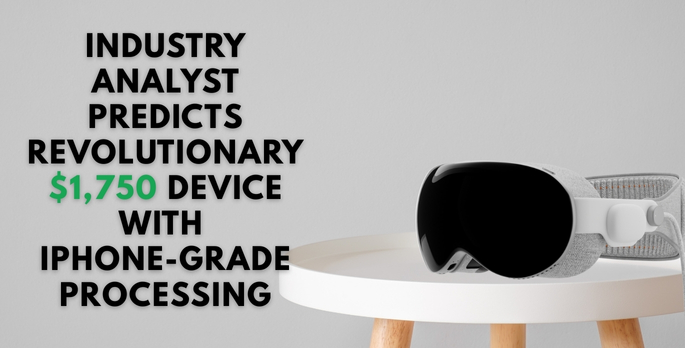
Industry Analyst Predicts Revolutionary $1,750 Device With iPhone-Grade Processing
In what could represent Apple's most significant push to democratize spatial computing since the Vision Pro's debut, renowned analyst Ming-Chi Kou reports that Apple is developing a substantially lighter and more affordable mixed reality headset dubbed "Vision Air" for release in 2027. The device is projected to be over 40% lighter than the current Vision Pro and approximately 50% more affordable, with a starting price around $1,750.
This strategic move aims to address the two most significant barriers to adoption of Apple's spatial computing vision: weight and price. The current Vision Pro, while technologically impressive, has seen limited market penetration due to its premium $3,499 price point and substantial weight of 1.375 pounds (600-650g).
Design and Materials RevolutionH5
Expected Vision Air vs. Vision Pro Design Comparison
| Feature |
Vision Pro (Current) |
Vision Air (Expected) |
Improvement |
| Weight |
1.375 pounds (600–650g) |
Under 0.825 pounds (<374g) |
>40% reduction |
| Starting Price |
$3,499 |
~ $1,750 |
50% reduction |
| Frame Material |
Aluminum |
Titanium / Magnesium alloy |
Lighter, more durable |
| External Material |
Glass |
Plastic |
Cost and weight saving |
| Chip |
M-series |
A-series (likely A21) |
Balanced performance |
The Vision Air's dramatic weight reduction will be achieved through several innovative material changes. According to multiple reports, Apple will replace the glass exterior with high-quality plastic components and utilize titanium for internal structures and connectors rather than aluminum. Some reports suggest magnesium alloy may also feature prominently in the frame construction.
The device is expected to sport a thinner profile and potentially come in a new "iPhone 5-era black" color option that appears as a graphite dark blue in certain lighting conditions. This would mark a departure from the current Vision Pro's predominantly silver aesthetic.
Leaked images suggest the Vision Air will also feature a new proprietary connector that's thicker than Lightning but designed for both data transmission and power. The battery enclosure is similarly expected to undergo redesigns contributing to the overall weight reduction.
Performance and Technical Specifications
Perhaps the most significant technical change comes in the form of processing hardware. Where the Vision Pro uses Mac-derived M-series chips, the Vision Air is expected to utilize Apple's A-series smartphone processors (likely whatever version powers the iPhone 19 Pro in 2027). This strategic shift balances performance with power efficiency and cost considerations.
Expected Technical Specifications Comparison
| Component |
Vision Pro |
Vision Air (Expected) |
| Chip |
M2 (8-core CPU, 10-core GPU) |
A-series (likely A21) |
| Memory |
16GB unified |
Possibly reduced |
| Storage |
256GB / 512GB / 1TB |
Similar options expected |
| Display |
Micro-OLED, 23 million pixels |
Possibly similar resolution |
| Sensors |
Extensive array (cameras, LiDAR, IMUs) |
Streamlined selection |
| Audio |
Spatial Audio with dynamic tracking |
Similar spatial capabilities |
This processor transition represents a calculated trade-off. While A-series chips typically deliver less raw performance than their M-series counterparts, they offer exceptional power efficiency and thermal management—critical factors for wearable devices. The A21 chip expected to power the Vision Air will likely be manufactured using TSMC's 2nm process technology, delivering substantial efficiency gains.
The Vision Air is also expected to feature a streamlined sensor array, potentially eliminating some of the Vision Pro's twelve cameras and sensors. Most speculation suggests the Eyesight display—which shows a rendered version of the user's eyes to people nearby—might be removed or significantly modified in the interest of weight and cost reduction.
Pricing Strategy and Market Position
At approximately $1,750, the Vision Air would occupy a dramatically different market position than its premium predecessor. This price point places it closer to high-end iPhones, Macs, and the anticipated foldable iPhone expected around the same timeframe.
Kou estimates Apple could sell one million Vision Air units in 2027, significantly surpassing the approximately 400,000 Vision Pro units sold since its launch. This projection underscores Apple's belief that accessibility rather than raw capability represents the primary barrier to spatial computing adoption.
The Vision Air appears positioned as a consumer-focused device compared to the Vision Pro's professional orientation. This strategy mirrors Apple's successful approach with other product lines where "Pro" devices target professional users with higher requirements and budgets, while standard or "Air" models cater to broader consumer markets.
Product Ecosystem and Timeline
The Vision Air represents just one piece of Apple's complex headset and glasses roadmap through 2028:
2025: Refreshed Vision Pro with M5 chip, maintaining current design and price point
2027: Vision Air launch alongside smart glasses (Ray-Ban Meta competitors)
2028: All-new Vision Pro with completely redesigned form factor and true AR glasses
This timeline suggests Apple views 2027 as a pivotal year for its wearable ambitions, with both the Vision Air and smart glasses potentially launching simultaneously. The smart glasses are expected to feature cameras, microphones, speakers, and support for phone calls, music playback, translations, and AI capabilities powered by an Apple-designed chip based on the efficient S-series processors used in Apple Watch.
Industry Context and Implications
Apple's move toward a more accessible headset aligns with broader industry trends. Meta's Quest headsets have historically dominated the consumer VR market through aggressive pricing, while companies like Real have pioneered lighter AR glasses formats. The Vision Air appears to represent Apple's attempt to bridge these approaches—offering substantial capability while approaching form factors and prices that could appeal beyond early adopters and professionals.
The success of the Vision Air may hinge not just on hardware specifications but on software and content development. Critics have noted that even the Vision Pro suffers from relatively limited dedicated content despite its capabilities. A larger installed base through the Vision Air could incentivize developers to create more spatial computing experiences, potentially creating a virtuous cycle of hardware adoption and software development.
Industry Context and Implications
Despite the promising specifications, the Vision Air faces significant challenges. Even at $1,750, it remains a premium product requiring compelling use cases to justify purchase. Additionally, the shift to A-series processors, while beneficial for cost and efficiency, might limit performance-intensive applications that have become showcase elements for the Vision Pro.
Comfort remains another critical factor. While a 40% weight reduction would represent a substantial improvement, some users note that even significantly lighter headsets can cause fatigue during extended use. The design team reportedly focuses on weight distribution as much as overall reduction.
Looking Forward
As with all pre-release information, these specifications and timelines remain subject to change based on production challenges, strategic shifts, and market conditions. However, consistent reporting from multiple sources suggests Apple is indeed committed to expanding its Vision lineup with more accessible models.