Grammarly, the popular writing assistance platform, has launched a groundbreaking update that transforms it from a grammar-checking tool into a comprehensive AI-powered writing ecosystem. The company announced today the release of eight specialized AI agents within its new "Docs" platform, representing one of the most significant expansions in the company's history.
The move comes after Grammarly's $1 billion funding round led by General Catalyst earlier this year and its acquisition of productivity startup Coda in 2024, signaling the company's ambitious pivot toward becoming a dominant player in the AI productivity space.
The New AI Agents: More Than Just Grammar Checking
Grammarly's new AI agents represent a fundamental shift from reactive corrections to proactive writing collaboration. Unlike general-purpose chatbots, these specialized digital assistants are designed to understand context and assist with specific writing needs throughout the entire writing process .
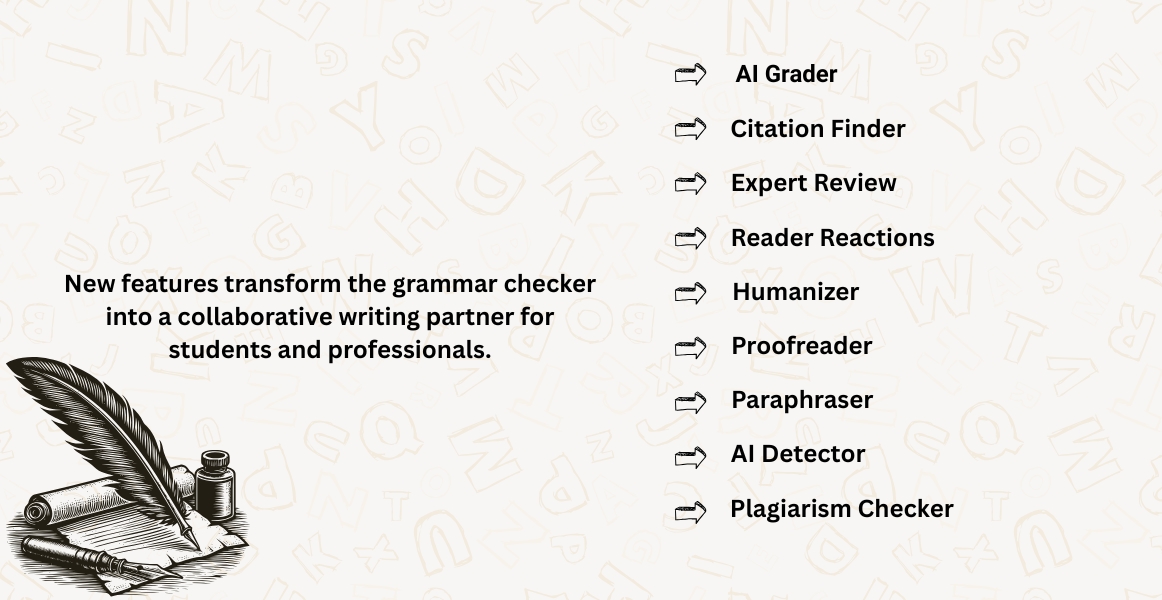
The nine launched agents include:
Specialized AI Writing Assistants
| Agent Name |
Primary Function |
Ideal For |
| AI Grader |
Provides rubric-based feedback and estimated grades |
Students, educators |
| Citation Finder |
Finds credible sources and generates proper citations |
Academic writing, research |
| Expert Review |
Offers subject-matter expertise and feedback |
Professional reports, technical documents |
| Reader Reactions |
Predicts how selected audiences will respond to writing |
Business communications, marketing |
| Humanizer |
Makes AI-assisted writing sound more natural |
Any AI-generated content |
| Proofreader |
Offers advanced suggestions for structure, clarity, and flow |
All writing types |
| Paraphraser |
Adapts writing for different audiences and tones |
Multi-purpose communication |
| AI Detector |
Identifies potentially AI-generated content |
Educators, content managers |
| Plagiarism Checker |
Scans for unintentional copying and missing citations |
Academic work, professional content |
Grammarly Docs: The New Writing Environment
At the heart of this transformation is Grammarly Docs, an AI-native document editor that serves as the home for these new agents. Unlike traditional word processors, Docs is built from the ground up with AI collaboration in mind, featuring a block-based approach that allows users to easily insert tables, columns, headers, and rich text elements.
"Docs is a writing surface with AI agents that work with you at every stage of your process, bringing stronger ideas you didn't see coming," according to Grammarly's official documentation.
The platform also includes an AI Chat sidebar that functions similarly to other AI assistants, helping users brainstorm ideas, summarize text, and generate suggestions in real-time. Unlike the company's previous browser extension that worked within other applications, Docs represents Grammarly's push to keep users within its ecosystem.
Specifically Designed for Students and Educators
In a first for the industry, Grammarly has explicitly targeted educational use cases with several of its new agents. The AI Grader tool stands out as particularly innovative, allowing students to upload their course rubrics and receive estimated grades based on their current drafts.
"Students today need AI that enhances their capabilities without undermining their learning," said Jenny Maxwell, Head of Grammarly for Education. "Grammarly's new agents fill this gap, acting as real partners that guide students to produce better work while ensuring they develop real skills that will serve them throughout their careers".
This educational focus addresses a significant gap in the market. According to Grammarly's research, only 18% of students feel "very prepared" to use AI professionally, while 66% of employers are actively seeking candidates with AI literacy.
Professional Applications for Business Users
Beyond academic applications, Grammarly's new agents offer significant value for professionals across industries. The Reader Reactions agent allows business users to preview how their writing might land with different audiences—whether tailoring a message for a CEO versus a sales team.
The Expert Review agent provides industry-specific feedback that would traditionally require access to subject-matter experts or senior colleagues. For example, a marketing manager could ensure their campaign messaging aligns with industry best practices before presentation.
"Grammarly's agents actually anticipate what your audience might ask and help you stay ahead of it," noted one review.
Accessibility and Pricing
The new agents and Docs platform are available to both free and premium Grammarly users, though some features—including the AI Detector and Plagiarism Checker—are currently exclusive to Grammarly Pro subscribers.
Enterprise and Education customers will gain access to all agents later this year, with specialized pricing and implementation options.
For now, these tools are primarily available within the Grammarly Docs environment at app.grammarly.com, though the company plans to roll them out across the 500,000+ applications and websites where Grammarly already operates.
Ethical Considerations and Academic Integrity
Grammarly's introduction of AI detection tools alongside AI writing assistants represents a delicate balancing act. When asked about this apparent contradiction, Luke Behnke, VP of enterprise product at Grammarly, explained that the AI detector is "not to provide an enforcement mechanism for teachers," but rather to "provide a window to students into what could be AI-generated text in their writing before they submit".
This approach reflects Grammarly's stated "moral imperative" to teach students how to use AI responsibly while preparing them for a workforce where AI literacy is increasingly essential.
Early reactions from educators have been mixed, with some welcoming the tools as a way to reduce writing anxiety while others question potential over-reliance on machine feedback.
The Future of Writing Assistance
Grammarly's transformation represents a broader shift in the productivity software industry toward AI-native experiences that actively collaborate with users rather than passively awaiting commands.
"The launch of our new agents and AI writing surface marks a turning point in how we build products that anticipate user needs," said Grammarly vice president Luke Behnke. "We're moving beyond simple suggestions to intelligent agents that understand context and actively help users achieve their communication goals".
This announcement comes just months after Grammarly's acquisition of email client Superhuman, signaling even more ambitious plans for expansion into the productivity space.
What's Next for Grammarly
While the current launch focuses on the Docs environment, Grammarly has announced plans to expand agent functionality across its entire ecosystem in the coming months. Real-time collaboration features are also in active development, addressing a current limitation compared to established document editors like Google Docs.
The company faces significant challenges in balancing its dual roles as both an enabler of AI writing and a detector of it, particularly in academic contexts. How this balance evolves may determine whether Grammarly becomes seen as a tool for enhancing human creativity or a shortcut that undermines it .
For the millions of students and professionals who already rely on Grammarly, these new agents represent both an exciting expansion of capabilities and a new learning curve to master. As AI becomes increasingly embedded in our writing tools, Grammarly's success may depend on its ability to enhance rather than replace human skill and voice..
Bottom Line:
Grammarly Docs and the new AI agents are available now at app.grammarly.com. The platform currently supports English only and is optimized for desktop use, with mobile support expected in future update.